
Some months give you an unplanned thread to follow. Without quite intending it, I found myself at three concerts across early summer – Rhiannon Giddens at Wigmore Hall, Cécile McLorin Salvant at Oxford’s new Stephen A. Schwarzman Centre for the Humanities the following night, and then, nearly two months later, the Jupiter Ensemble’s Late Night Baroque Prom at the Royal Albert Hall – the same world of Renaissance and Baroque song turning up again, this time under the dome of the Albert Hall.
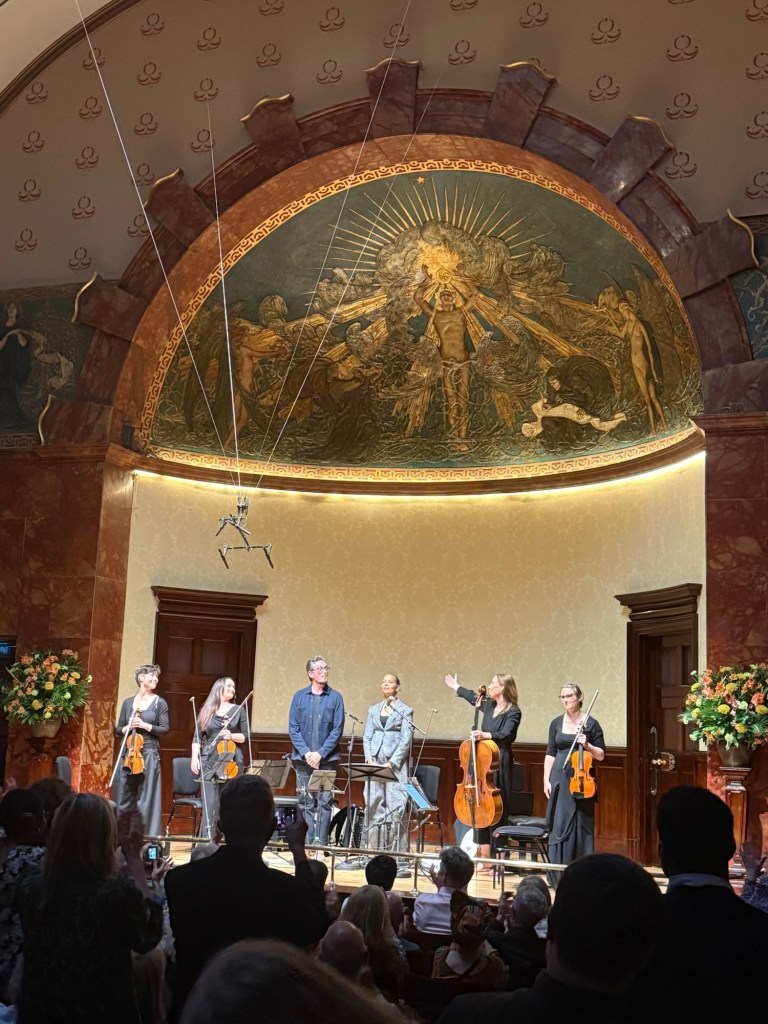
Wigmore Hall, 27 May — Rhiannon Giddens
Giddens closed her residency at Wigmore Hall with Francesco Turrisi and Ireland’s Crash Ensemble; a Grammy-winning, Pulitzer-winning musician (for her opera Omar) whose work moves through folk, country, and early music with real historical seriousness rather than genre tourism. I had the joy of sitting next to a couple that introduced themselves as avid Giddens fans, and shared how they follow her avidly. This is a compelling performance; I wasn’t expecting banjo and viola from the same artist, but the songs were vibrant and very much felt like living music.
Schwarzman Centre, Oxford, 28 May — Cécile McLorin Salvant
The following evening, in Oxford, Giddens turned up again – this time in a thirty-minute pre-show conversation ahead of Cécile McLorin Salvant’s Book of Ayres in the Sohmen Concert Hall. Giddens was clearly idolised by Salvant! She was so keen to ask the questions, but it was clear they were interesting artists that could have spoken at length beyond the realms of the 30 minutes.
The Schwarzman Centre is impressive, and the foyer felt similar to King’s Place in the uncertainty of where one goes once you enter the building. Seeing the list of disciplines and departments that now occupy the same territory was inspiring.
Salvant herself is a singer, composer, and visual artist whose work refuses to sit still; three consecutive Grammy Awards for Best Jazz Vocal Album, a MacArthur Fellowship, and a restless curiosity that runs from vaudeville and blues to baroque and folkloric song. Book of Ayres drew on early English song repertoire – Dowland, Campion, and their contemporaries – filtered through her own instincts as a storyteller. What struck me about the performance was the 360° nature of it; this was not simply a reinterpretation of early music, nor was it a reimagination in terms of performance practices alone. This was a reimagining as an event, and perhaps there was something authentic in delivering these well known songs through her own artistry and idiosyncratic vocal capabilities. Her vocal prowess is wonderful; the quiet singing was ethereal and controlled.
One detail I keep returning to: manuscripts were projected during the performance; the actual pages of the source material, Dowland and his contemporaries’ original notation, hovering above the stage as Salvant sang. But also there were artistic inserts to the projections, not only extracts of scores. I didn’t see this as some afterthought or extraneous detail to the music: this seemed to provide a lens into the thinking of the performers and the singing. We were seeing the starting points for the reimaginings.
Royal Albert Hall, 21 July — Late Night Baroque
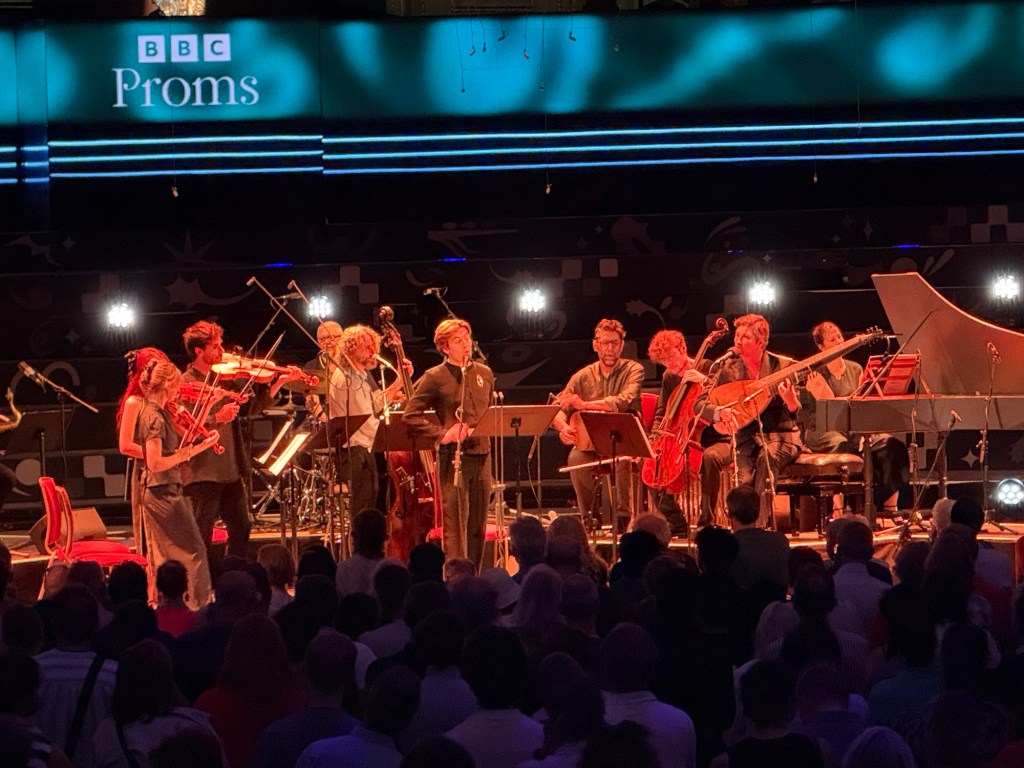
Nearly two months later, the same repertoire resurfaced in an entirely different setting: the Jupiter Ensemble’s Proms debut, built around Dowland – marking the 400th anniversary of his death – alongside Purcell and Handel, tenor Laurence Kilsby lending voice to songs of “love’s pains and pleasures,” directed from the lute by Thomas Dunford. Hearing this music in the vastness of the Royal Albert Hall, with the rock-star aspirations of Thomas Dunford made for an enjoyable evening.
The evening didn’t stay entirely within its historical borders; new compositions crept in, and the night closed with a Baroque-inflected cover of “Hey Jude.” Perhaps some of the Prommers had trains to catch, but many were sneaking out during the encores; I’m sure not for the quality of the playing and singing but for the urgency to make final trains.
What stayed with me, across all three nights, was how much scholarship was quietly woven into each of them; not as an academic add-on, but as part of the performance itself. The Salvant evening made this most visible: those projected manuscripts turned an act of historical editing and reconstruction into something the audience watched happen, in real time, alongside the singing. The Proms and Wigmore evenings carried a similar sense of the scholarship being present, even without anything as literal as projected manuscripts; programme notes, spoken introductions, the musicians’ own evident command of the sources came across in the way this music was owned and presented. Knowing Giddens would be a scholar soon at the Schwarzman Centre made sense; her musical scholarship is housed beautifully in the interdisciplinary spaces of the centre.
It’s less any single performance than the throughline between them: the same Renaissance and Baroque song repertoire – Dowland above all – refracted across two months and three very different rooms, each treating the material as something alive and actively researched rather than roped off. Having been involved in the British Academy’s SHAPE initiative in its early days, making the case for the humanities’ value across disciplines, it was hard not to see all three evenings – and the Schwarzman Centre itself – as a live answer to that same argument: scholarship and performance in the same room, sometimes literally on the same screen, rather than kept in separate ones.
It leaves me with a genuine idea, not just a pleasant memory of three good nights out. Those projected manuscripts at the Schwarzman Centre in particular kept nagging at me: that’s exactly the kind of material (primary sources made visible, scholarship turned into something a young person can actually see happening) that could anchor a proper set of curricular resources for schools. Dowland’s 400th anniversary this year, three very different performing traditions all drawing on the same handful of songs, manuscripts you can project on a classroom screen as easily as a concert hall one; there’s a genuinely rich, ready-made project here, connecting early music scholarship directly to what happens in a GCSE or A-level classroom. It’s the kind of thing I’d love to explore with the Centre directly, alongside the wider schools engagement conversation already underway there.
This isn’t a new instinct for me. Earlier this year I was part of the original team, working with composer Julian Philips, devising Learning with Found Material: Melodys of Earth and Sky for NMC Recordings – a project built with the Southwark Schools Learning Partnership that took Philips’ own compositional process as the starting point for a new digital GCSE and A Level composition resource, alongside in-school mentoring for Year 12 composers across seven schools. I helped shape the resource itself and worked directly with the schools involved from the project’s earliest stages. It taught me how much appetite there is among students and teachers for exactly this kind of thing: not a simplified version of “real” scholarship, but the actual working material of a living composer, made usable in a classroom.
All of these performances remind me that it’s through high-quality scholarship that these inventive and imaginative performances are enabled; modelling these behaviours in educational outreach will bring the humanities alive for children and youth people. It’s through the interaction of a range of disciplines that make artists and their art special.


Leave a Reply